

Designing a cannabis facility affects everything that happens inside it. When you look at how to design a cannabis facility, the layout of the rooms, coordination of the systems and construction of the building all influence crop consistency, code compliance and long-term operational return on investment (ROI). When these details are handled with care, the building will support the steady production and help your team work confidently from day one.
But poor designs can lead to crop contamination, Occupational Safety and Health Administration (OSHA) issues like allergies, wasted energy and costly retrofits. These problems slow down operations and often require corrections that could have been avoided, especially when you need a building that stays compliant, runs efficiently and remains profitable under demanding conditions.
This article covers how workflow planning supports a cleaner, safer facility, why commercial grow room design plans need attention and how HVAC systems fit into the overall build.
Cannabis Facility Design: Predesign Planning
Predesign planning begins with understanding how the business will operate. A clear direction for production goals, canopy size and workflow guides the early layout so the facility can support daily work without constant adjustments.
- Business model alignment: Define whether the facility focuses on cultivation, processing or a blended operation so the design reflects actual needs.
- Zoning, approvals and environmental regulations: Confirm local rules for cannabis use, odor control and wastewater requirements before drawings move forward.
- Power, water, drainage and waste planning: Verify that the building has the utility capacity, reliable electrical load, steady water access and proper drainage.
- Site access, loading, fire lanes and structure capacity: Make sure the property can support equipment movement, emergency vehicle access and any structural needs tied to the building’s layout, like widened openings or higher ceiling requirements.
Cannabis Facility Layout and Workflow
A strong layout supports the daily movement of plants, staff and materials. Each area should feel intentional so work can continue without confusion or unnecessary travel.
Clean-to-Dirty Movement
A clean-to-dirty workflow keeps production moving forward without exposing plants to unnecessary risk. Cloning, vegetative growth, flowering, drying, curing and processing should follow a steady path so plants never circle back into earlier zones.
This sequence helps prevent cross-contamination and gives the team a predictable route to follow as the plants mature.
Functional Room Adjacencies
Room adjacencies influence how smoothly teams can work throughout the day. Cloning rooms are typically located close to early vegetative rooms, allowing trays to travel short distances during transitions. Flowering rooms benefit from direct access to drying spaces, which limits travel time for the harvested product.
Processing, storage and packaging areas are often together, making material handling feel efficient rather than scattered throughout the building. When rooms are grouped according to related tasks, the building supports the actual rhythm of cultivation.
Corridor Width and Storage Access
Corridors need enough width to move rolling benches, carts and equipment without slowing down the team. Space for turning, passing and staging becomes important as the number of daily tasks increases. Storage access should sit along these corridors rather than tucked into an isolated corner.
Employees can retrieve tools, hoses, spare parts or sanitation supplies without walking across production areas or interrupting other tasks. Good corridor placement also reduces congestion during harvest windows when movement increases significantly.
Service Routes and Works Zones
Service routes can be separated from main work pathways, allowing maintenance crews to access mechanical or electrical rooms without passing through active growing areas. These routes give contractors a direct line to equipment during repairs or inspections.
Work zones are placed along these paths to keep noisy or disruptive tasks away from rooms that require quieter conditions. This type of layout also limits foot traffic inside sensitive production areas, which keeps the environment calmer for both the staff and the plants they manage each day.
Modular Wall Systems
Modular wall systems offer flexibility for cannabis facilities that anticipate future changes. Panels can be installed quickly, removed cleanly or relocated without disturbing the rest of the building. The surfaces hold up against humidity, irrigation and daily sanitation.
Modular construction also creates uniform room sizes, allowing consistent placement of benches, lights and equipment. When adjustments are needed, the wall system adapts without creating weeks of demolition or causing lengthy shutdowns of active growing rooms.
Moisture-Resistant Finishes
Moisture-resistant finishes handle daily washing, nutrient spills and condensation that are common in active cultivation rooms. Coated walls and sealed flooring prevent water from seeping into the structure and reduce long-term wear.
These finishes facilitate the maintenance of sanitary conditions on surfaces during high-production cycles. They also reduce the chance of hidden moisture developing behind walls, which protects the rest of the building from damage caused by high-humidity environments.
Lighting Access and Ceiling Height
Ceiling height influences how lighting, ductwork and racking systems can be arranged. Warehouse grow room design needs enough vertical clearance for fixtures, airflow paths and service access. Lighting must be reachable without moving benches or dismantling equipment.
Wider spacing between fixtures and adequate working room above aisles improved staff performance in repairs and replacements. Ceiling height also affects how heat builds inside the room, so layout choices account for both electrical placement and day-to-day maintenance demands.
Scalability and Expansion
Scalability keeps the facility adaptable as production goals shift over time. Open adjacencies provide space for additional canopy areas, new equipment lines or upgraded systems without requiring a reorganization of the entire floor plan.
Early planning can reserve space for future drying rooms, expanded veg areas or new processing zones. When the building includes flexible locations for utilities and access points, expansion can be handled during scheduled downtime, rather than forcing shutdowns or delays in ongoing production.
Building Systems
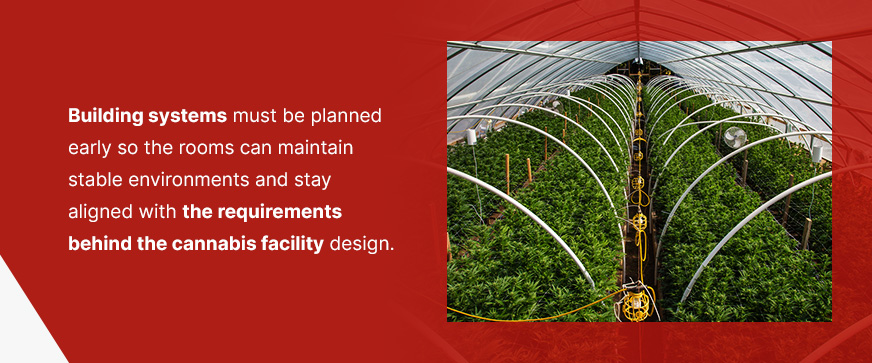
Building systems support the interior conditions that a cannabis operation depends on. These systems must be planned early so the rooms can maintain stable environments and stay aligned with the requirements behind the cannabis facility design.
Here are the main system elements to account for when designing a cannabis facility:
- Mechanical, electrical and plumbing systems serve the full workflow of a cultivation building
- HVAC sizing is based on the temperature and humidity needs of each grow room
- Flowering rooms carry higher moisture loads and need stronger dehumidification capacity
- Duct routing should follow the room layout to keep airflow consistent across the canopy
- Equipment needs enough clearance for technicians to reach filters, coils and condensate lines
- Electrical distribution must manage lighting loads, mechanical equipment and automation
- Dedicated panels keep lighting schedules separate from the mechanical circuits
- Emergency shutoffs belong near room entries for quick access during maintenance
- Backup power protects essential systems during outages
- Water systems support irrigation, fertigation and sanitation throughout the facility
- Reverse osmosis units need clear paths to nutrient tanks
- Supply lines should remain accessible along service routes
- Floor slopes guide water toward trench drains or sump pumps
- Air filtration helps contain odor and airborne debris
- Sealed mechanical chases reduce unwanted air movement between rooms
- Coordinated system layouts prevent ductwork, conduit and piping from clashing
Security, Compliance and OSHA Requirements
Security, compliance and OSHA standards are important because they dictate the necessary measures that must be in place for the facility to operate legally and safely. These requirements affect how the building is constructed, how staff move through it and what systems need to be in place before inspections can be approved. These include:
- Controlled access at restricted doors
- Camera coverage for corridors and storage rooms
- Locked areas for product, waste and chemicals
- Odor control equipment at exhaust points
- Fire protection coordinated with ceilings and ductwork
- Ventilation for chemical rooms and work areas
- Lighting levels that support safe movement and tasks
- Air quality monitoring in active production zones
Building for Long-Term Durability
Poor planning, inconsistent layouts, undersized systems and compliance gaps can slow production and increase costs in a cannabis facility.
Alta Construction works with businesses that need a contractor familiar with the demands of cannabis cultivation and processing. Our team coordinates the rooms, utilities and systems involved in designing a cannabis facility, using tools like Procore, Bluebeam and Raken to communicate and schedule in an organized manner.
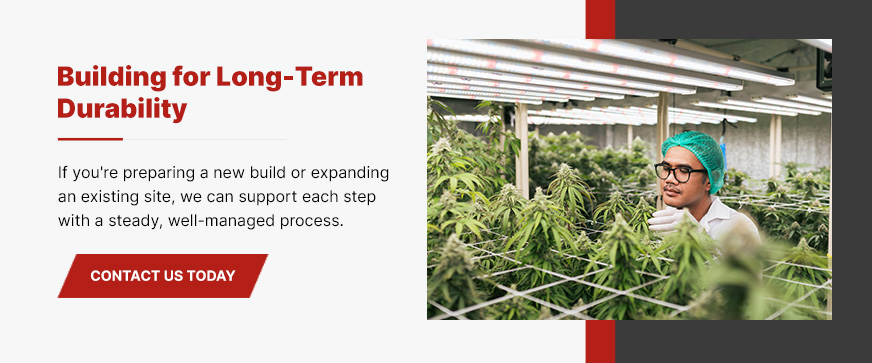
If you’re preparing a new build or expanding an existing site, we can support each step with a steady, well-managed process. Contact us today to discuss the cannabis facility you want to create.